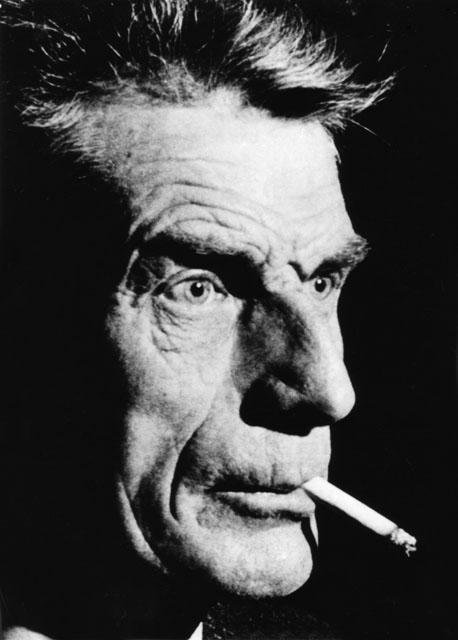
Based on: Rockaby, Breath and Not I by Samuel Beckett
With: Elinor Middleton, Joseph Cauthery
Stage design and costumes: Maia Oprea and Yi-Xing Hwa
A song by Trevonic
Dramaturgy: Olga Dimitrijevic
A performance by Mihai Lucaciu
Silent as the Grave can be understood as I, they, we, you are all ghosts within this performance. There is no I to whom the speaking, performing, acting, living can be attributed. Beckett’s work calls for an innacted performance that is unnamable, resistant to subjectivity, authority and identity. What we are trying to find here is a rhythm, in order to comprehend the process of relating to spectators and to see and hear the ghosts, so-called our characters. The spectator is encouraged to find the right fillings/feelings in our show, its intensity is increased through repetitions and denials/affirmations of the shared/ experience. The gaps and static moments in our show are to be filled by spectators that are to face the minimalist construction of the characters, their signs of loneliness, their index cards as narrators and especially their bodily dis/appearance. In an Artaudian sense, these small Beckettian extreme texts have an internal music that is to be discovered by the spectator. That specific sound of a rocking chair that is approaching and holding off the spectator is one of the strongest internal musical elements to be found here. Beckettian ghosts are deprived of money, but also youth, health, fortitude and even a body, as in Not I. Protagonists dry out along with the world they inhabit, the world of a freakshow, where lonely people are exhibited by a vicious Master of Ceremonies. Even their names disappear. Whether they have lived is also uncertain. What we are left with is a special type of respiration as in Breath: the breath of ghosts. Silent as the Grave becomes a schemata of respirations. Breath remains virtual and can achieve its materiality through the dynamic process of relating the audience, by accepting intentional performative correlatives, a game that the spectator is invited to play. By putting together three of the most difficult, extreme and controversial plays by Beckett, all these parts interact and give shape to a sideshow of ghosts. The three segments are not documentary records or something that exists or existed before, but a ghostly reformulation of an already formulated reality, which brings into your world as spectator something that did not existed before the performance. You answer to the call of the freakshow ghosts. Indeterminacies of the performance, its own gaps, and its long static moments are making way for a filling; they anticipate other gaps and various meanings from an active audience. They do not tell a lot about what is actually going on, that part that you are supposed to figure out yourself, in the exquisite position of being a spectator. What you should try here is to stick to your own interpretation as spectator and to try to get away safe till the end of the show. By focusing on the details, breath becomes an animating principle that fills out the details of the internal action of our lonely ghosts, but without reaching any conclusions. Each word and action has to be discovered step by step and this quest constructs the atmosphere of the performance. There is a process of sedimentation, where you accumulate knowledge about possible ghosts and experience. Behind this waiting and distant expectation, there is an active, inner, vibratory perceptibility. Our ghosts are immobilized, their voices become stronger because of stillness and absence. Timing, rhythm and musicality of the words are giving a style of breathing, in the same time giving you time to develop and create the shape of your ghosts. Words have the effect of the Chinese water torture, they are painful to be heard and they are difficult to be shared. The dilation and compression go one by one, our characters seem detached talking or hearing about someone else, they seem very affected talking about the same persons. These sensitive delimitations are hard to grasp but they give a special rhythm to the show. The effects of these short plays are like ebb and flow. Beckett’s schematas are shaping our ghosts but their recognition depends on how you react to it, how you are capable to pick up some of the falling pieces and put them together. Our performance comes to life during this process but its meaning is impossible to identify straightforward outside the performing space and remains virtual on paper. But exactly this possibility, this openness to meaning, can give dynamism to our show and like an ouija board for spiritism, can give voice to ghosts. By questioning different lines of forces, different perspectives on Beckettian lonely ghosts and the whole identity of an I in these three plays, the spectator sets the performance in motion and the results can be relevant only for yourself. This innacted performance gives you something and you give something back to it. As Malone, another Beckettian ghost, once said: Live or invent. The show unfolds its potential through a process of being part of the performance through invention. Through you, the spectator, this performance comes to a shape, to a form of life that is still fragile, even when the meaning can be no longer relevant. Because in theatre we are able to experience things that no longer exist and to approach things that are totally unfamiliar to us. At the end of the show, with the help of the confusing Master of Ceremonies, you can be puzzled: did you get a glimpse of her missing presence, did you understood what was going on there if something was actually going on, or better to say did you understood your reactions in the face of these three plays and your own loneliness? By negating the existence of the lonely characters on stage, you were affirming yourself as their companion for the walk, and through this symbiosis you are the only one who can affirm their existence. She is she and without you, she won’t exist, but on the other side, you won’t be real as you are now real without her, because now you can perceive and recognize your own reactions and feelings towards this boring show. And this is what it’s all about: becoming lonely with your own reactions after our show by being exposed to Beckettian forms of loneliness in an anti-Beckettian performance. Nothing more than a proposition.


